
What is industrial crepe paper and why it is a strategic technical material
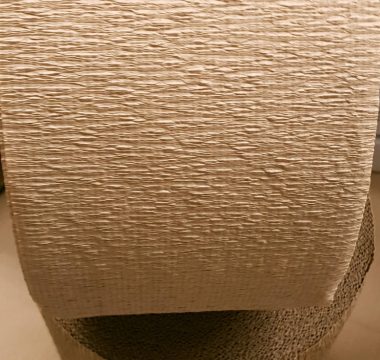
Industrial crepe paper is characterized by a micro-pleated structure obtained through a wet creping process that generates controlled longitudinal elasticity and increases transverse elasticity. This configuration provides differentiating properties compared to other technical papers:
- Greater elongation capacity
- Better absorption of dynamic stresses
- Adaptability to irregular surfaces
- Good performance in industrial stitching
Unlike conventional paper, industrial crepe paper does not perform a merely wrapping function, but rather a structural role within the production process.
In industrial environments, it is mainly used in:
- Closing and reinforcement of industrial sacks
- Electrical and dielectric applications
- Protection of sensitive components
- High-speed automated processes
Its performance depends directly on technical parameters that must be analysed individually.
Technical variables that determine the performance of industrial crepe paper
Optimizing the use of industrial crepe paper implies understanding which variables affect its actual behaviour in production.
Basis weight selection
Basis weight influences strength, dimensional stability and machine performance.
- Low basis weights → greater flexibility
- Medium basis weights → structural balance
- High basis weights → greater mechanical strength
An insufficient basis weight may cause tearing at tension points. An excessive basis weight may hinder stitching or generate unnecessary rigidity.
Elasticity and controlled elongation
Elasticity is the distinctive property of industrial crepe paper. It allows stresses to be absorbed without rupture, especially in:
- Automatic stitching processes
- Handling of sacks with variable loads
- Lines with vibration or impact
However, elasticity must be consistent with the application. Excessive elongation may affect dimensional accuracy.
Tensile strength
Longitudinal and transverse strength determine stability under load. In demanding industrial applications, industrial crepe paper must maintain integrity even under repetitive stresses.
Behaviour of industrial crepe paper in automated lines
One of the critical factors in high-performance environments is compatibility with automated processes.
Unwinding and tension in the roll
Uniform winding guarantees stability during unwinding. Tension variations may generate deviations or micro-tears.
Properly manufactured industrial crepe paper maintains homogeneity in width, thickness and internal tension.
Compatibility with industrial stitching
In the closing of industrial sacks, industrial crepe paper must:
- Withstand repeated perforations
- Maintain cohesion at the stitching point
- Prevent tear propagation
An unsuitable material may cause line stoppages and increased incidents.
Impact of industrial crepe paper on production efficiency
Optimization is not only technical, but also economic.
Correct selection of industrial crepe paper makes it possible to:
- Reduce waste due to breakage
- Minimize reprocessing
- Stabilize cycle times
- Improve final product quality
In high-volume production, small improvements in behaviour may translate into significant reductions in indirect costs.
Sector applications of industrial crepe paper
Electrical sector
In transformers and electrical components, industrial crepe paper acts as an adaptable insulating material, covering irregular surfaces and improving dielectric distribution.
Agrochemical and food industry
In industrial sacks, industrial crepe paper reinforces the closing area and improves structural resistance against granular or powdery products.
Technical surface protection
Its elasticity and absorption make it a suitable solution for technical packaging where light cushioning is required.
Criteria for choosing industrial crepe paper according to application
The choice must be based on:
- Type of product contained
- Line speed
- Stitching system
- Level of applied tension
- Environmental conditions (humidity, temperature)
Industrial crepe paper must be considered part of the technical design of the process, not an accessory element.
Quality control and stability of industrial crepe paper
To ensure consistent performance:
- Verify basis weight homogeneity
- Control thickness variations
- Analyse mechanical strength
- Carry out pilot tests in real environments
A supplier specialized in industrial crepe paper can adapt technical parameters to specific needs.
Industrial crepe paper as a strategic component
Industrial crepe paper is not an auxiliary material, but a technical element with direct impact on efficiency, safety and quality. Its proper optimization requires detailed analysis of the production process and appropriate selection of specifications.
When integrated strategically, industrial crepe paper contributes to reducing incidents, stabilizing automated lines and improving overall performance.
Do you need to optimize your industrial crepe paper?
Each production process presents specific requirements in terms of tension, speed, strength and mechanical behaviour. Therefore, the choice of industrial crepe paper must be based on detailed technical analysis and not solely on standard specifications.
At Arrosi, manufacturers of crepe paper, we develop industrial crepe paper solutions adapted to specific application requirements, ensuring stability, homogeneity and consistent performance in highly demanding environments.
If you would like to evaluate which technical configuration best suits your process, our team can help you analyse critical variables such as basis weight, elasticity, strength or roll format.
Contact us to study your application and optimize the performance of your industrial crepe paper. You can follow all our news on our LinkedIn profile.
FAQs about industrial crepe paper
What basis weight of industrial crepe paper is most common?
It depends on the application, although in reinforcement of industrial sacks medium and high basis weights are usually used.
Is industrial crepe paper compatible with automation?
Yes, provided that it is adapted to speed and stitching system.
Can the format be customized?
It can be supplied in rolls adapted to specific widths and technical specifications.
Does fibre quality influence performance?
Yes, it affects strength, stability and behaviour in the presence of humidity.