Far from being a secondary factor, moisture directly influences the mechanical and functional properties of crepe paper and must therefore be considered from the application design stage.
Moisture as a Critical Variable in Cellulosic Materials
Crepe paper is a cellulose-based material and, as such, exhibits hygroscopic behaviour: it tends to absorb or release moisture depending on environmental conditions. This characteristic, far from being a drawback in itself, is part of its natural behaviour and must be properly managed.
In industrial applications, moisture may originate from multiple sources:
- Environmental conditions within the workspace
- Contact with damp products or surfaces
- Processes involving condensation or temperature variations
Controlling these variables is essential to ensure material stability during use.
How Moisture Affects Wet Strength Crepe Paper
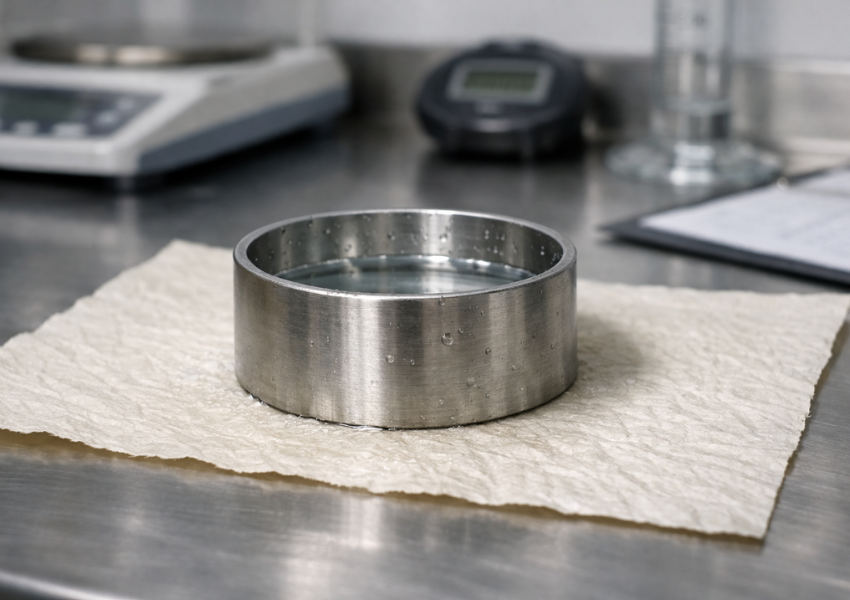
The interaction between crepe paper and moisture results in measurable changes in its physical behaviour. The most relevant effects include:
- Variation in mechanical strength, especially tensile strength
- Modification of elasticity, linked to the degree of creping
- Dimensional changes, with possible expansion or contraction
- Alteration of surface texture, which may influence friction or grip
These effects do not occur abruptly but progressively, and depend both on the level of humidity and the duration of exposure.
Crepe Paper and Moisture: Functional Balance
Technical crepe paper operates within a controlled moisture range. In this context, the material maintains a functional balance that allows it to fulfil its purpose without loss of performance.
This balance is achieved through:
- Appropriate basis weight selection
- Control of the manufacturing process
- Adjustment of the degree of creping
- Correct selection according to the use environment
For this reason, not all crepe papers behave in the same way in the presence of moisture, and it is essential to choose technical solutions adapted to each application.
Implications in Poultry Applications
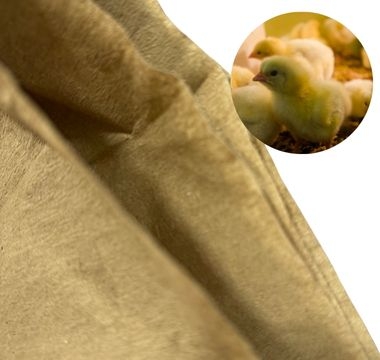
In poultry applications, such as chick start-up with crepe paper or incubation, ambient humidity forms part of the operating environment. In these cases, crepe paper must maintain its integrity for the time required to perform its function, without premature degradation or loss of stability.
The behaviour of crepe paper in the presence of moisture influences:
- The continuity of the support surface
- The tactile and auditory response of the material
- Animal safety and welfare
Inadequate selection may result in a loss of functionality earlier than expected.
Relevance in Industrial Packaging and Protection
In industrial technical packaging and product protection, moisture may appear during storage, transport or handling. Crepe paper used in these applications must be able to adapt to such conditions without compromising the protection provided.
Controlled behaviour in the presence of moisture allows:
- Maintenance of cushioning capacity
- Prevention of premature tearing or breakage
- Preservation of packaging stability
This aspect is particularly relevant in industrial packaging solutions, where crepe paper acts as a functional material rather than a decorative one.
Crepe Paper and Moisture in Electrical Applications
In certain electrical applications, moisture control is a critical factor. Although crepe paper is integrated into systems designed to operate under specific conditions, its behaviour in the presence of moisture forms part of the overall technical assessment of insulation performance.
In these cases, crepe paper is selected according to:
- Dimensional stability
- Compatibility with other system materials
- Long-term behaviour
Moisture is not analysed in isolation, but as part of the operating environment of the electrical system.
Technical Factors Influencing Behaviour in the Presence of Moisture
The behaviour of crepe paper in the presence of moisture does not depend on a single factor, but on a combination of technical variables defined during the material design phase. Depending on the fibre, the manufacturing process, treatments and additives, it is possible to develop crepe papers with different responses to moisture, adapted to specific industrial requirements.
Variables Determining Material Response
- Type and quality of fibre used (virgin or recycled fibre, blends, refining): determines porosity, capillarity and dimensional stability.
- Crepe paper manufacturing process (basis weight, density, structure, creping, calendering): defines the balance between elasticity, strength and hygroscopic behaviour.
- Applied treatments (sizing, impregnations, surface treatments): direct performance towards absorption, wet strength or improvements in resistance to moisture transmission, depending on the application.
- Design of the degree of creping: allows adjustment of the interaction between paper and water (for example, modulating strength retention or response under exposure conditions).
Typical Functional Responses Depending on Paper Design
- Moisture-absorbent crepe paper: prioritises capillarity and absorption to manage moisture in the application.
- Moisture-resistant / wet strength crepe paper: seeks to maintain integrity and mechanical performance during exposure to humidity or condensation.
- Paper with controlled disintegration or loss of integrity in a wet environment: designed so that its behaviour in the presence of water is predictable according to the intended use.
- Paper with improved resistance to moisture transmission (barrier effect): achievable when specific treatments are incorporated to reduce permeation, always depending on real operating conditions.
Selecting the Appropriate Crepe Paper According to the Environment
Understanding the relationship between crepe paper and moisture facilitates technical decision-making at the project stage. The objective is not to avoid moisture in all cases, but to select a material whose behaviour is compatible with the environment in which it will operate.
This criterion is essential in applications where crepe paper fulfils a specific technical function and forms part of a broader system.
A Key Factor in Material Reliability
Behaviour in the presence of moisture is one of the aspects that define the reliability of crepe paper in industrial applications. Analysing it from a technical perspective makes it possible to anticipate material performance and optimise its use across different sectors.
If you need advice on which type of crepe paper is best suited to specific humidity conditions, or if you would like to clarify technical questions about its behaviour in a particular application, you can contact the Arrosi team via their contact page: https://arrosi.com/en/contact
You can also follow technical updates and case studies on Arrosi’s LinkedIn profile, where solutions applied to different industrial environments are shared.
Frequently Asked Questions (FAQs)
Does crepe paper lose strength with moisture?
Strength may vary depending on the level of humidity and duration of exposure, which is why it is important to select the appropriate material for each environment.
Do all crepe papers behave in the same way in the presence of moisture?
No. Behaviour depends on basis weight, degree of creping and manufacturing process.
Does moisture invalidate the use of crepe paper in technical applications?
Not necessarily. In many cases, it forms part of the expected operating environment.
Is it possible to use crepe paper in environments with controlled humidity?
Yes, provided that a technical crepe paper designed for that context is selected.
Why is it important to consider moisture at the design stage?
Because it directly influences material stability, durability and functionality.