Why Crepe Paper Is Key in the Hygiene Industry
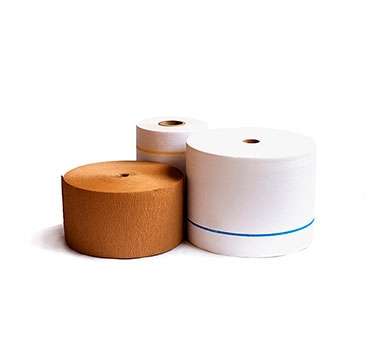
Crepe paper is widely used in the production of wet wipes, cleaning products, and disposable medical materials, where the performance of the base material defines the effectiveness of the final product. Its micro-creped structure provides high absorbency and mechanical resistance, even in humid or high-friction conditions.
Unlike flat or non-woven papers, crepe paper offers a flexible and adaptable texture. It can serve both as an absorbent substrate and in laminated combinations with other functional layers, such as in wipes, packaging, or sanitary products.
You can learn more about these uses in the wet wipes section of Arrosi’s website.
Technical Properties of Crepe Paper for Hygiene Products
Absorbency and Moisture Control
One of the most valued characteristics of crepe paper is its high absorbency, inherently greater than that of non-creped papers. This advantage comes from its three-dimensional structure, which increases surface area and enhances liquid retention.
Arrosi has developed high-absorption crepe papers that take this feature even further, ensuring better performance in hygiene applications. This helps prevent excess moisture release and ensures product integrity during use — a critical factor in meeting any quality and safety standard.
Mechanical Strength and Dimensional Stability
Creping does not directly increase traditional tensile strength, but it adds elasticity, allowing the paper to deform without tearing and absorb more energy under stress. In material science, elasticity measures how much energy a material can store before it yields.
This elasticity enables crepe paper to better absorb tension in high-handling zones. In demanding industrial applications — like converting or wet wipes production — this energy absorption helps the paper resist tearing, thus supporting the required quality and safety standard in hygiene products.
At Arrosi, we manufacture high-performance crepe papers tailored for such uses, as detailed in our article on absorbent and durable crepe paper for wet wipes.
Compatibility with Surface Treatments
Crepe paper can be treated with coatings or impregnations — such as waxes, paraffins, or hot-melts — that enhance its suitability for specific uses. In the hygiene industry, this means tailoring permeability, softness, or sealing capacity to meet application needs.
Such versatility ensures that crepe paper complies with the quality and safety standard required for humid environments and products with active agents like disinfectants or lotions.
Grammage Control and Uniformity
Precise control of grammage and creping is essential to ensure a consistent quality and safety standard. Arrosi uses continuous monitoring systems to maintain uniformity across the paper surface, preventing tension zones or thickness variations that could compromise product performance.
Certifications and Quality and Safety Standards
The hygiene industry demands full compliance with recognized quality and safety standard frameworks and certifications that ensure traceability and environmental responsibility. Arrosi’s crepe papers are FSC® certified, guaranteeing responsible sourcing from sustainably managed forests.
In addition to certification, Arrosi maintains internal quality procedures, from pulp and additive selection to physical and mechanical testing of each batch. This comprehensive approach ensures each roll meets the specific quality and safety standard expected by professional hygiene and cleaning manufacturers.
Applications of Crepe Paper in Hygiene Products
Crepe paper is used throughout various production stages and product types. Its most relevant applications include:
- Wet and cleaning wipes, as an absorbent layer or reinforcement
- Medical and hospital-grade materials, where preventing contamination is critical
- Laminated papers for cosmetic and cleaning product packaging
- Inner reinforcements in packaging requiring strength and softness
Our article on Crepe Paper in Wet Wipes Production outlines the technical requirements crepe paper must meet in high-speed manufacturing lines, where consistent creping and tensile strength are crucial to meeting any quality and safety standard.
Sustainability and Traceability in the Supply Chain
Sustainability is an integral component of any modern quality and safety standard in the hygiene sector. Arrosi champions the use of specialty papers that merge technical performance with environmental responsibility. FSC® traceability ensures manufacturers can verify the material’s origin and meet evolving regulatory requirements in the European market.
Arrosi’s ability to customize crepe paper — in terms of grammage, crepe type, and absorption level — helps optimize production processes, reduce waste, and improve energy efficiency.
Beyond Hygiene: Related Technical Applications
The same properties that make crepe paper suitable for hygiene also make it valuable in other technical sectors. For example, in stitched agrochemical packaging, it provides tear resistance and heat-seal adaptability — as detailed in our article on stitched crepe paper for agrochemical packaging.
Quality and Safety as the Foundation of Innovation
Crepe paper plays a critical role in the hygiene industry thanks to its balance of absorbency, durability, and adaptability. Arrosi ensures that each product complies with the highest quality and safety standard, reinforced by FSC® certification and rigorous internal controls.
To explore Arrosi’s full range of hygiene-grade paper solutions, visit: https://arrosi.com/en