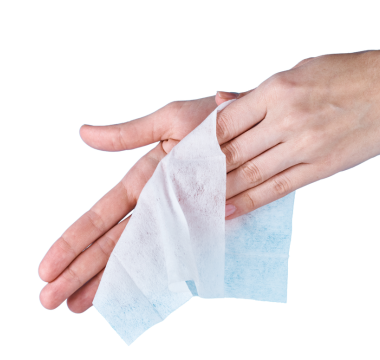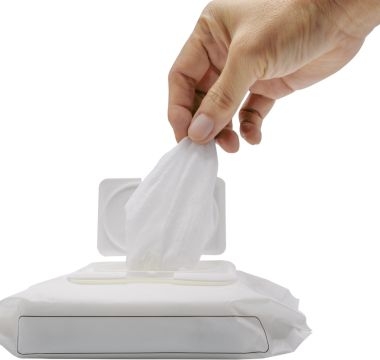
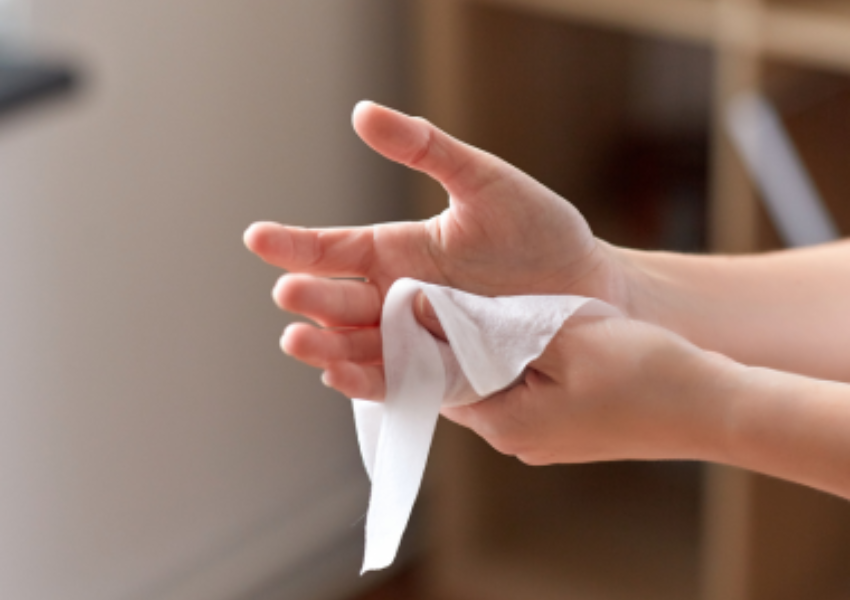
What Is the Role of Crepe Paper in Wet Wipe Production?
Crepe paper is a controlled-deformation material offering high cross-directional elasticity, good absorbency, and excellent handling in automated production lines. These features make it a suitable base substrate for specific wet wipe formats, especially in industrial, professional hygiene, and technical cleaning sectors. Thanks to its micro-crimped texture, it improves liquid retention and facilitates the impregnation of wetting solutions.
For more details on its performance in cleaning and moistening applications, see the related article: Crepe Paper: An Absorbent and Resistant Material for Wet Wipes.
When more advanced functional features are required—such as increased rigidity, wet strength, or precise absorption levels—it can be combined with other specialty papers developed by Arrosi. These include embossed paper, paraffin-coated paper, polyethylene paper, greaseproof paper, bituminized paper, or even complementary materials like tissue gauze. Each adds specific technical value depending on the formulation and wet wipe type.
What Materials Compete with Crepe Paper in Wet Wipe Manufacturing?
In the wet wipe sector, crepe paper is commonly compared with three major material families:
1. Synthetic Nonwovens
Primarily made from polyester, polypropylene, or viscose blends.
Advantages:
- Excellent wet strength
- Dimensional stability
- Smooth and uniform texture
Disadvantages:
- Lower environmental sustainability
- Difficult to recycle
- Petrochemical-based
2. Cellulose-Based Nonwovens
Made from natural or regenerated fibers such as viscose or lyocell.
Advantages:
- High softness
- Good absorbency
- Improved environmental profile vs. synthetics
Limitations:
- Higher cost
- Complex manufacturing processes
- Lower initial stiffness compared to technical papers
Each substrate serves specific functions in wet wipe manufacturing: barrier effect, strength, wet stability, or sealing capacity.
Technical Comparison: Crepe Paper vs. Other Substrates
Elasticity and Production Line Behavior
Crepe paper offers natural cross-directional elasticity and is ideal for lines requiring tension control and adaptability.
Synthetic nonwovens provide unidirectional strength but are less flexible.
Absorption and Liquid Impregnation
- Crepe paper: Quick wetting and strong retention
- Tissue gauze & embossed paper: Increase volume and absorption
- Synthetic nonwovens: Good absorbency with viscose, lower with 100% synthetics
Wet Strength
Synthetic materials provide higher absolute wet strength.
Crepe paper and specialty papers can enhance this through reinforcement treatments or layered structures.
Sustainability
Crepe paper and Arrosi specialty papers are made from FSC®-certified fibers, ensuring responsible sourcing.
Synthetics are harder to recycle and carry a higher environmental impact.
Material Applications in the Wet Wipe Sector
Crepe Paper
Ideal for:
- Industrial wet wipes for machinery and equipment cleaning
- Professional wipes used in technical maintenance
- Products requiring high impregnation and moderate strength
Synthetic Nonwovens
Best suited for:
- Cosmetic or hygiene wet wipes needing maximum softness
- Applications with intense wet mechanical stress
Advantages of Crepe Paper and Specialty Papers Over Synthetics
1. Sustainability and Traceability
FSC®-certified fibers ensure a responsible and transparent supply chain. Specialty papers reduce polymer usage and improve recyclability.
2. Industrial Process Optimization
Crepe paper can undergo micro-deformations, reducing breakage and enhancing line performance during cutting, folding, and wetting stages.
3. Functional Adaptability
Combining crepe paper with tissue gauze, hot-melt-coated paper, or paraffin paper allows a wide range of technical wet wipe formulations.
Practical Use Cases of Crepe Paper in Wet Wipes
Case 1: Machinery Cleaning Wipes
Crepe paper with reinforcement is used to absorb light lubricants and ensure stable performance in emulsified environments.
Case 2: Professional Maintenance Wipes
A blend of tissue gauze and technical paper balances absorption and durability.
Case 3: Specialty Impregnated Wipes
Polyethylene paper acts as a partial barrier, or paraffin paper is used for oil-based applications.
FAQs – Materials for Wet Wipes
Can crepe paper fully replace nonwovens in wet wipes?
It depends on the application. For industrial uses, crepe paper is an effective alternative. For cosmetics or intimate hygiene, nonwovens offer greater softness.
What is the most sustainable material for wet wipe production?
FSC®-certified specialty papers offer the best combination of performance and sustainability.
Can different specialty papers be combined in a single wet wipe?
Yes, multilayer structures allow hybrid solutions with distinct functional layers.
Which Material to Choose for Wet Wipe Manufacturing?
Choosing the right material for wet wipe production involves balancing absorption, sustainability, strength, and function. Crepe paper stands out as a sustainable and technically advanced alternative, especially when combined with specialty papers like tissue gauze, embossed paper, greaseproof paper, or paraffin paper. For tailored solutions, consult Arrosi’s full catalog of specialty paper materials.
Arrosi: Manufacturer of Crepe Paper and Specialty Papers for Technical Solutions
Arrosi produces crepe paper, tissue gauze, reinforcement papers, paraffin paper, polyethylene-coated paper, embossed paper, greaseproof paper, bituminized paper, hot-melt papers, and other FSC®-certified specialty papers. Arrosi’s technical team offers support in material selection, functional specifications, and wet wipe development. Contact us through the official website: https://arrosi.com/en