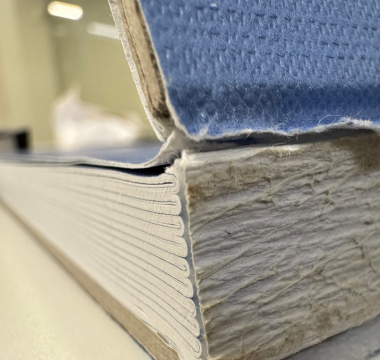
What Does Crepe Paper Weight Mean?
The crepe paper weight refers to the weight of the paper expressed in grams per square meter (g/m²). This value indicates the amount of fiber present in the material’s structure and, therefore, affects its mechanical behavior.
In the case of crepe paper used in bookbinding, the crepe paper weight not only determines the material’s weight but also key characteristics such as:
- Flexibility
- Tear resistance
- Ability to adapt to the book spine
- Durability in final use
For this reason, selecting the right crepe paper weight is essential to avoid issues during manufacturing or in the product’s later use.
Why Crepe Paper Weight Is Key in Bookbinding
Bookbinding requires materials capable of withstanding repeated mechanical stress. The spine of a book, for example, is subjected to constant bending during opening and closing.
The crepe paper weight directly influences how the material responds to these demands.
Flexibility in the Book Spine
Crepe paper has a crimped structure that provides high elongation capacity. However, the crepe paper weight determines how much flexibility can be maintained without compromising strength.
A weight that is too high may hinder adaptation to the spine, while one that is too low may reduce structural stability.
Resistance to Sewing and Handling
In sewn binding processes, the material used to reinforce the spine must withstand repeated perforations without tearing.
An appropriate crepe paper weight allows the material to resist the tension generated by thread and handling during manufacturing.
Durability in Book Use
Books, planners, and notebooks are subject to prolonged use. The crepe paper weight influences the material’s ability to maintain its structural integrity over time.
Selecting the correct crepe paper weight helps extend the lifespan of the final product.
How to Choose Crepe Paper Weight According to Binding Type
There is no single crepe paper weight suitable for all projects. The choice depends on the type of binding and the expected material performance.
Hardcover Bookbinding
In hardcover books, the spine requires reinforcement that is both flexible and strong. The crepe paper weight must allow proper bonding between the page block and the cover.
In these applications, weights are chosen to provide:
- Good tear resistance
- Structural stability
- Adaptability to spine movement
This balance is essential to avoid failures when opening the book.
Production of Planners and Notebooks
In the manufacturing of planners or notebooks, the crepe paper weight often prioritizes flexibility and ease of handling during production.
The material must adapt to:
- Industrial runs
- Binding machinery
- Repeated opening cycles
Sewn Binding
When binding involves sewing, the crepe paper weight must offer sufficient strength to prevent tearing at perforation points.
The combination of appropriate crepe paper weight and creped structure allows the material to absorb stress without compromising spine integrity.
Technical Factors That Influence Crepe Paper Weight Selection
The crepe paper weight is a key criterion, but it is not the only factor to consider.
Other technical aspects also influence material selection.
Fiber Type
The quality of the fiber used in paper manufacturing directly affects material performance.
Papers made from high-quality fibers provide greater strength and stability, even at lower crepe paper weight levels.
Creping Level
The creping process creates a wavy structure in the paper that increases elasticity.
A higher creping level can compensate for lower crepe paper weight, providing additional flexibility without reducing strength.
Binding Process Conditions
Each production line has specific requirements.
The crepe paper weight must be adapted to:
- Machine speed
- Type of adhesive used
- Sewing or gluing system
For this reason, preliminary testing is often carried out to determine material performance in each industrial environment.
Common Mistakes When Selecting Crepe Paper Weight
Choosing the wrong crepe paper weight can lead to technical problems in bookbinding.
Common mistakes include:
Selecting Weight Based Only on Cost
A lower crepe paper weight may reduce material costs but can increase the risk of tearing or structural failure.
Not Considering the Final Application
Each type of book or notebook has different requirements. Using the same crepe paper weight for all applications can lead to performance issues.
Ignoring Interaction with Other Materials
The crepe paper used in the spine works together with other components such as structural board.
In hardcover books, additional structural elements like the spine stiffener also contribute to overall binding stability.
Crepe Paper as a Technical Solution in Bookbinding
Crepe paper has become a key material in the publishing and bookbinding industry thanks to its combination of strength and flexibility.
Selecting the correct crepe paper weight allows you to optimize material performance and improve the quality of the final product.
By analyzing factors such as binding type, process conditions, and product requirements, it is possible to determine the most suitable crepe paper weight for each project.
Arrosi, a crepe paper manufacturer, develops crepe paper for industrial applications tailored to the technical requirements of sectors such as professional bookbinding.
Arrosi: Expertise in Manufacturing Crepe Paper for Bookbinding
Understanding crepe paper weight and its behavior in binding processes makes it possible to select the most suitable material for each application. Factors such as flexibility, tear resistance, and adaptation to the book spine must be evaluated together to ensure a reliable technical result.
At Arrosi, as a specialized manufacturer of crepe paper for industrial applications, we develop solutions tailored to the requirements of sectors such as professional bookbinding. If you need advice on the most suitable crepe paper weight for your project, you can contact our team.
Additionally, if you want to stay updated on industry trends, new crepe paper applications, and our latest industrial developments, you can follow Arrosi on LinkedIn.
FAQs About Crepe Paper Weight in Bookbinding
What crepe paper weight is used in bookbinding?
The crepe paper weight used depends on the type of binding and the required level of strength. In industrial applications, weights are selected to balance flexibility and tear resistance.
Why is crepe paper weight important?
The crepe paper weight influences the durability, flexibility, and stability of the material during manufacturing and use.
Can a low crepe paper weight affect binding?
Yes. A crepe paper weight that is too low can reduce material strength and increase the risk of tearing at the spine or sewing points.
Is crepe paper weight the only important factor?
No. In addition to crepe paper weight, factors such as fiber quality, creping level, and binding process conditions also influence material performance.