This approach is especially relevant during the brooding phase, where small environmental adjustments can directly impact flock uniformity and animal welfare.
Sensory Stimuli and Pecking Behavior
The natural behavior of chicks is heavily influenced by visual, tactile, and auditory stimuli. When these are properly integrated into the environment, the animals respond more quickly and coherently.
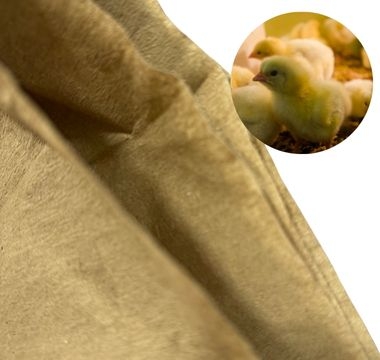
Crepe paper provides a combination of cues that trigger this behavior:
- Auditory stimulation, through the soft sound created when walking or pecking.
- Tactile stimulation, thanks to its unique texture underfoot.
- Visual reference, by creating a distinct surface compared to the floor.
The interaction of these stimuli reinforces exploratory behavior and helps chicks identify functional areas more efficiently.
Sound as a Positive Functional Stimulus
Unlike other environments where sound is considered a factor to be minimized, in this early stage the sound produced by contact with crepe paper serves a positive function. The gentle crackling acts as an attraction element, sparking curiosity and reinforcing movement toward the area where feed is located.
This principle is well established in the use of crepe paper during chick brooding: the sound is not eliminated but intentionally leveraged to guide chicks toward feed and water zones during the first hours of life.
Crepe Paper and Early Access to Feed and Water
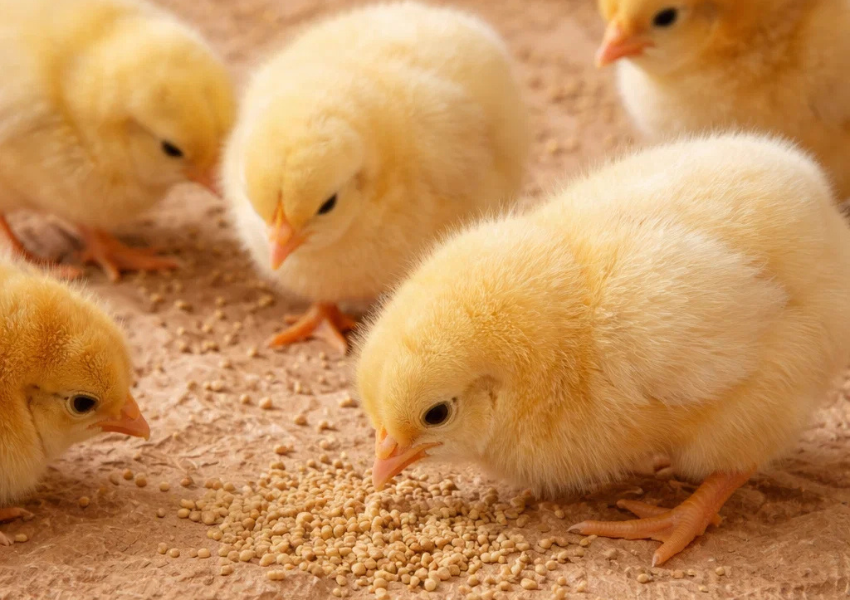
One of the key challenges in the early behavior of chicks is ensuring that their first contact with feed and water happens as soon as possible. Crepe paper supports this goal in several ways:
- The auditory stimulus draws chicks to the surface.
- Pecking on the paper naturally transfers to the feed placed on top.
- The movement of a few birds stimulates the response of the entire group.
This collective activation effect helps reduce dispersion and promotes more uniform intake, especially in large flocks.
Role of Crepe Paper Within the Brooding Phase
Although the focus here is on sensory stimulation, its application is part of the broader chick brooding phase. In this context, crepe paper acts as a complementary element that strengthens system design and improves chicks’ early response.
For a more comprehensive look at crepe paper in brooding, visit:
https://arrosi.com/en/blog/crepe-paper-for-raising-chicken
Importance of Crepe Paper Formulation
Not just any paper will deliver this effect. For sensory stimulation to be effective, technical-grade crepe paper with specific characteristics for poultry use is required:
- Appropriate grammage to generate stimulus without losing integrity.
- Sufficient mechanical resistance during early hours.
- Controlled moisture behavior.
- Uniform texture for consistent sensory response.
Material selection directly influences behavioral outcomes and overall efficiency.
Practical Application in Poultry Systems
Crepe paper integrates easily into existing poultry systems, placed in areas designed to activate initial behaviors, especially under feed and water lines. This solution is part of Arrosi’s technical offerings for the livestock sector, aligned with animal welfare and operational efficiency standards.
Explore the full brooding and transport application at:
https://arrosi.com/en/applications-and-sectors/farming-and-transportation-of-chickens-pigs
A Sensory Stimulus Serving Welfare and Efficiency
Technical crepe paper for chick brooding goes far beyond covering a surface. When used correctly, it becomes a behavioral activation tool that encourages early access to feed and water, improves flock uniformity, and contributes to a more efficient and controlled brooding phase.
To evaluate which type of crepe paper best suits your system or to address technical questions about its use, contact the Arrosi team through: https://arrosi.com/en/contact
You can also follow Arrosi on LinkedIn for technical insights and real-world use cases in the livestock industry.
Frequently Asked Questions (FAQs)
Does the sound of crepe paper cause stress to chicks?
No. In this early phase, the sound acts as a functional stimulus that triggers pecking and exploration.
Can any crepe paper be used for this purpose?
No. Technical crepe paper with proper grammage, strength, and moisture response is necessary.
Does this replace proper brooding design?
No. Crepe paper is a complementary element within a well-designed brooding system.
Can it be used in any poultry facility?
Yes, as long as the appropriate material is chosen and properly integrated into the feed and water system.
What is the main benefit of this approach?
It promotes faster, more uniform activation of early behavior, with a positive impact on welfare and efficiency.